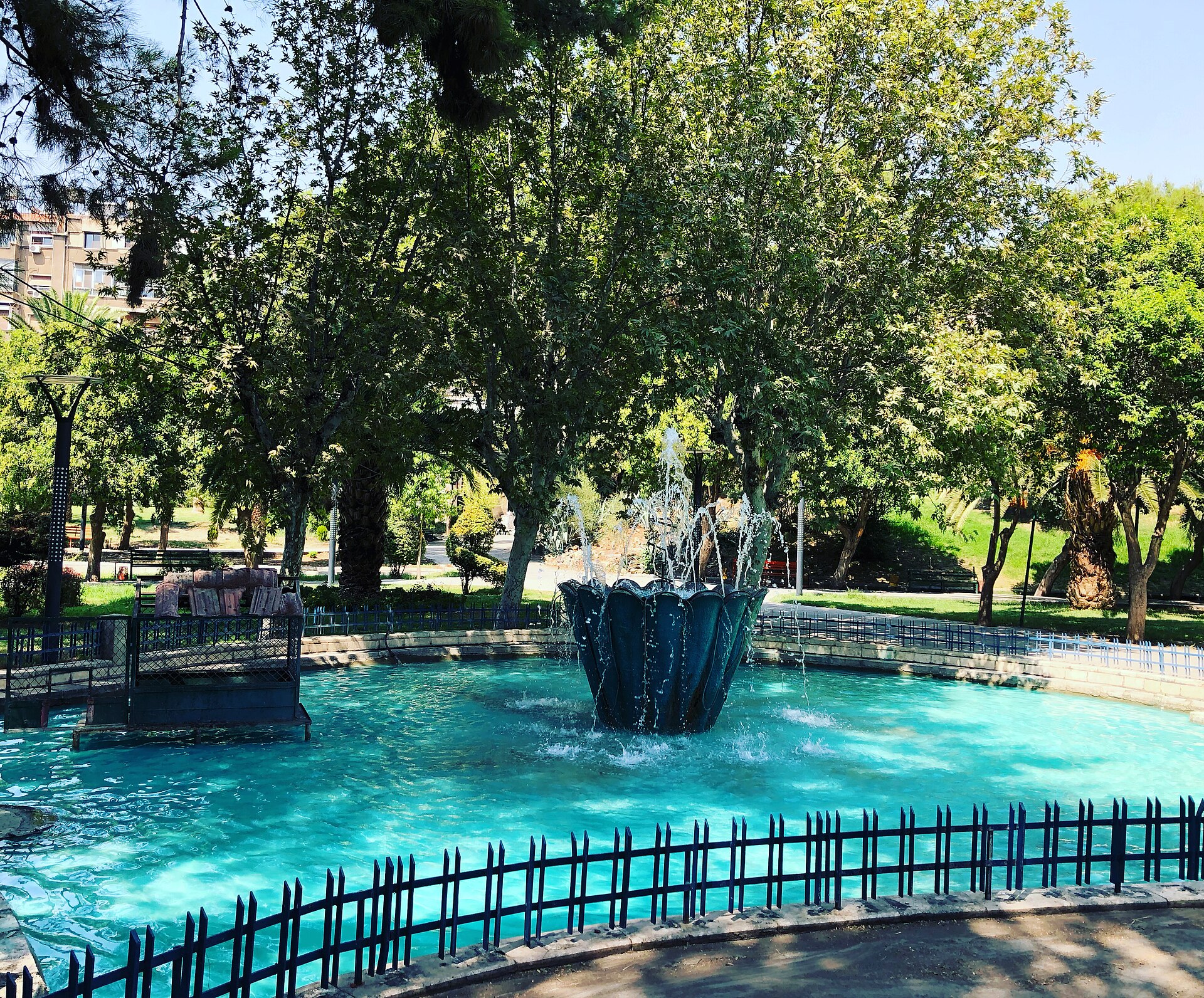
Al-Jahiz Park in Damascus — a fountain among mature trees, one of the city's loved district parks

Damascus, Syria · Context & Benchmark

The parks Syria already has

Syria loves its parks — Tishreen's flower show, Aleppo's 1949 Public Park, Hama's riverside gardens, evening corniches. This page maps what exists, what it teaches, and the gap Al Adawi Park is sized to fill. Every claim is labelled; areas without public records are marked to be validated.

01  Why Benchmark

Not starting from zero — starting from what Syrians already love

Syria has a real park culture: family picnics, evening promenades, flower shows, riverside gardens. What it does not have is a large, climate-designed, universally accessible park at metropolitan scale. Reading the existing parks honestly tells us exactly what Al Adawi must keep, and what it must add.

17 ha
Aleppo Public Park — Syria's largest formal park Verified
≈300 ha
Al Adawi Park — deed-verified plot (2,935,090 m²) Verified
~17×
the scale jump over the largest existing formal park Calculated
>3,000 → 100s
hectares of Ghouta green belt lost around Damascus Verified trend

02  Damascus Parks

The capital's green rooms today

Damascus's named parks — Tishreen, al-Jahiz, al-Sibki, al-Tijara, al-Wahda — are loved and heavily used, but they are district-scale gardens in a metropolis of millions, backed by the memory of the Ghouta.

Al-Malki · Damascus

Tishreen Park

The largest park in Damascus, laid out in late 1969 on the former Kiwan orchards near Umayyad Square and Tishreen Palace. Home of the Damascus International Flower Show (established 1973), which at its peak drew hundreds of thousands of visitors a year.

Verified Area unrecorded publicly — to be validated

Lesson: a signature annual event can give a park a citywide, even national, identity.

City centre · Damascus

Al-Jahiz Park

A central, mature garden with playgrounds, benches, long paths and water pools — the photograph above this page. Small in area, big in daily life; one of the city's oldest loved green rooms.

Verified

Lesson: shade, water and seating — not size — are what make a Damascus park loved. Al Adawi scales that formula.

Shaalan · Damascus

Al-Sibki Park

The Shaalan district's family default — playgrounds and everyday gathering in one of the densest, most walkable quarters of the modern city.

Verified (existence)

Lesson: proximity wins. Parks embedded in walkable fabric are used daily, not occasionally.

District gardens · Damascus

Al-Tijara & Al-Wahda

Smaller named gardens in the city's roster of public parks — pocket-scale relief in a tight urban grid, each serving its immediate blocks.

Verified (existence)

Lesson: the city's park network is made of fragments; none offers a full-day destination.

Around the city · Damascus

The Ghouta — the park Damascus already had

For centuries the real recreation ground of Damascus was not a park at all: it was the Ghouta oasis, the irrigated orchard belt fed by the Barada, where families went on weekends. Urbanisation has reduced it from more than 3,000 hectares to a few hundred.

Verified

Lesson: Al Adawi is not importing an idea — it re-grounds the Ghouta habit on one of its last surviving edges.
03  Across Syria

How other Syrian cities take their air

Each city has its own habit of public greenery — a formal park, a river edge, a seafront. Together they show a national appetite for outdoor civic life that has never been answered at scale.

Aleppo · founded 1949

Aleppo Public Park

Syria's largest formal park at about 17 hectares — a hexagonal composition between the Jamiliyeh and Aziziyeh districts, with the Queiq river running through it. Proof that Syrian cities have built and kept great civic parks for generations.

Verified

Aleppo

Al-Snoubari Park

Another of Aleppo's established public parks — evidence that even Syria's second city runs a network of district greens rather than one large landscape.

Verified (existence)

Hama

The Norias riverside

Hama's gardens and promenades gather along the Orontes around the ancient wooden norias — the waterwheels that are the city's icon. Green space and moving water, inseparable.

Verified (existence)

Latakia

The seafront corniche

On the coast, public life takes its evening air along the Mediterranean corniche — promenade culture rather than park culture.

Verified (existence)

Entries kept deliberately conservative: only parks and habits with public documentation are named; sizes are stated only where recorded (Aleppo Public Park). Other areas to be validated

04  The Scale Gap

What exists is loved. What's missing is scale.

Set the country's largest formal park beside the Al Adawi site and the gap is the argument: Syria's park culture has never had a landscape big enough to hold it.

Park scale — hectares, side by side

Recorded areas only; a typical Damascus district park is shown as an indicative order of magnitude. Al Adawi is the deed-verified plot from the locked DWG register. Verified Indicative

Tishreen Park — Damascus's largest — is omitted from the bars because no reliable public area figure exists; it is smaller than the Al Adawi site by any published account.

0
Syrian parks today at metropolitan (100 ha+) scale
1969 · 1949
Damascus and Aleppo built their flagship parks generations ago — the tradition exists
≈300 ha
Al Adawi: the first Syrian park sized to its metropolis (deed-verified)

05  Lessons

Six lessons the existing parks hand to Al Adawi

Keep · from Tishreen

The signature event. The Flower Show proves an annual ritual can anchor national attention — Al Adawi's festival grounds and programming calendar carry that forward.

Keep · from Al-Jahiz

Shade, water, seating. The loved parks are the cool ones. Al Adawi makes canopy and moving water the base layer, not decoration.

Keep · from Al-Sibki

Walk-in proximity. Daily use comes from the surrounding blocks — 68,000 people live within a 15-minute walk of Al Adawi.

Add · scale

A full-day landscape. Nothing today holds a family for a whole day. 250 measured hectares can — lawns, orchards, water, culture, sport.

Add · climate design

Beyond the lawn-and-bench era. Existing parks predate climate-first design. Al Adawi is shade-first, evening-led, water-wise from the ground up.

Add · universal access

Inclusion as baseline. Step-free routes, quiet gardens and legible wayfinding at a standard no Syrian park has yet set.

Syria's parks prove the appetite. Al Adawi answers it at the scale of the city — the first park in the country sized to its metropolis, designed for its climate, and open to every ability.

Sources: Wikipedia — Tishreen Park, Aleppo Public Park, Damascus (parks list), Al-Snoubari Park; lovedamascus.com (Tishreen); middleeasteye.net (the gardens of Damascus); ibnbattutatravel.com (Al-Jahiz). Ghouta trend as documented in the research report.