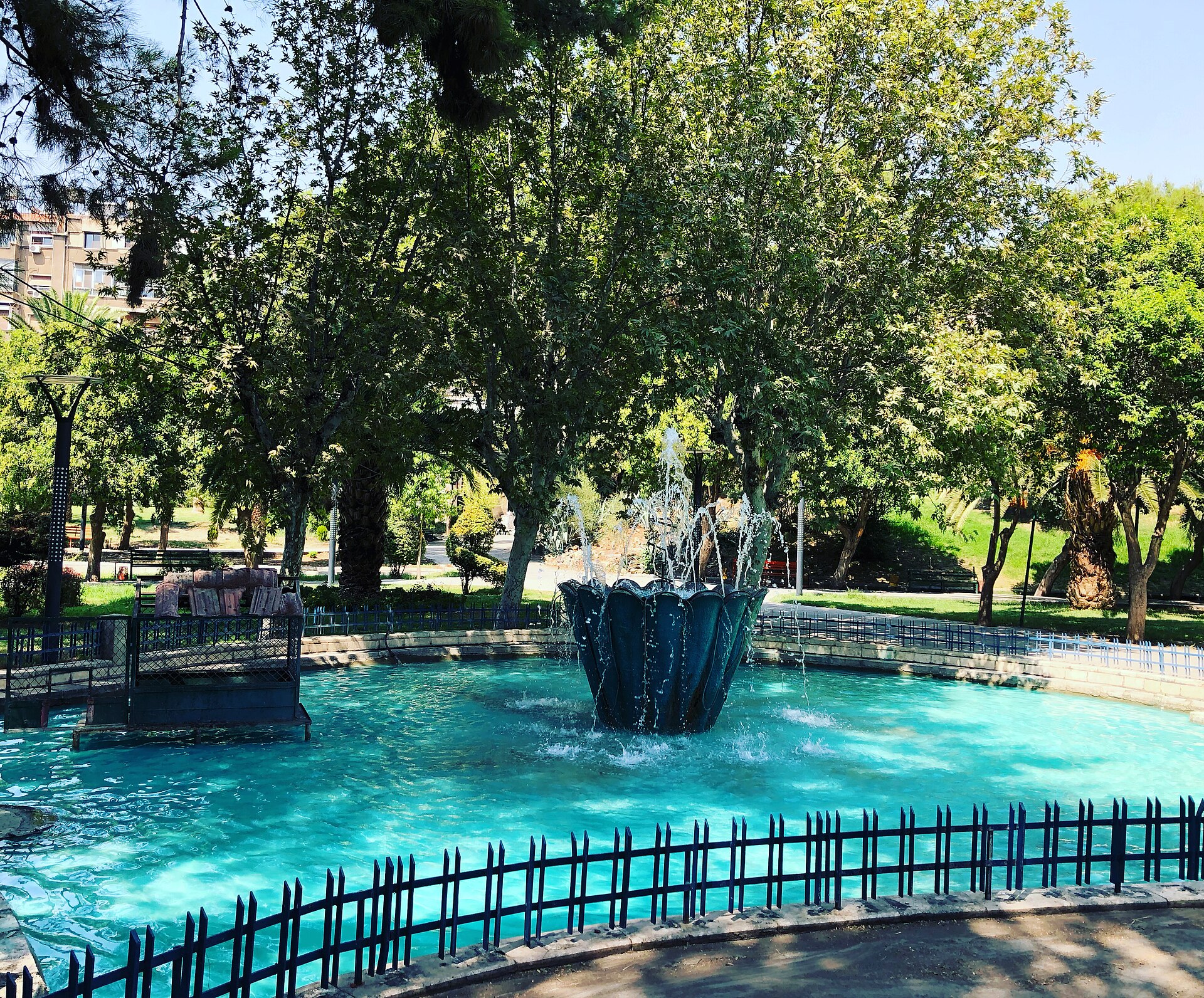
A busy public park in Damascus — families among mature trees around a fountain

Damascus, Syria · People & Demand

A park for everyone in Damascus

Who Al Adawi Park serves, and how many. A visitor-and-community demand model built for a young, family-led city — with an inclusion-first design so that every age and every ability belongs. All figures are labelled planning scenarios, not measured counts.

01  Visitor & Community Demand

Capacity, scenarios & the design day

Al Adawi Park sits inside a metropolis of millions with almost no large quality parks. Demand is therefore led by the surrounding community, then deepened by families, youth, culture and heritage tourism. The model below is scenario-based and conservative — sized on a ~40 ha usable public core within the ≈300 ha deed-verified plot (2,935,090 m², locked register).

560,000
annual visits — working base case Provisional
5,000
design-day benchmark (simultaneous) Provisional
80 m²
space per visitor at the design day (comfort target)
68,000
residents within a 15-min walk (radius-based)
Annual visitor scenarioRange / figure
Existing informal use (today)120,000–180,000
Opening year350,000–480,000
Working base case560,000
Stabilised base case620,000–820,000
High activation820,000–1,000,000
Stretch case1,000,000–1,200,000
Daily use modelVisitors / day
Quiet weekday900–1,400
Typical weekday1,400–2,200
Active weekday (evening-led)2,000–3,000
Weekend day3,500–5,000
Peak family weekend4,500–6,000
Festival / national day (managed)up to 30,000

Comfort density by scenario

Usable public core ≈ 40 ha (400,000 m²). More visitors → less space each. The design day (5,000) holds an 80 m²/visitor comfort target. Provisional

+210% to +700%
growth potential from today's informal use to stretch case
~40%
family-led demand (local + citywide families)
Evening
summer demand is evening-led; peak load is the family weekend
02  Catchment Demographics

Who lives around the park — a decisively young catchment

Syria is one of the youngest countries in the region, and the districts wrapped around Al Adawi — Rukn al-Din, Abu Jarash, Mazraa — are dense, family-led quarters beside one of the Arab world's largest universities. The park's first constituency is young, and the plan is written for it.

≈23
median age in Syria (2024) Verified
29.2%
of the population aged 0–14 Verified
51.5%
under 25 — the park's core crowd Verified
4.7%
aged 65+ — included, never an afterthought Verified

Age profile of the 15-minute catchment

Syria's 2024 national age structure applied to the ≈68,000-person radius catchment. Calculated Local census to confirm

What the local evidence adds

  • Abu Jarash recorded 12,798 residents at the 2004 census — the immediate quarter alone is a small town.
  • The densest edges face NE / E / N — 220, 189 and 185 mapped buildings within 250 m of the three pedestrian gates: the young, walkable fabric of Rukn al-Din.
  • Damascus University's Faculty of Agriculture adjoins the site — a daily student population on the doorstep.
  • Post-2011 displacement means current age splits need re-survey — national structure is the honest planning basis. To be validated

Designing for the young majority

Sport & movement · 15–24s

Courts, the wellness loop and open kick-about lawns near the university and NE edges — where roughly one in five locals is 15–24.

Social edges & shade

Shaded gathering steps, evening promenades and café courts — the free "third place" a young, dense city lacks, alive after sunset in summer.

Digital engagement

Wayfinding, events and the visitor assistant live on the phone — see the Smart Park & AI strategy for the full stack.

Events & culture

A festival calendar, open-air cinema and the craft market give teenagers and students a reason to return weekly, not yearly.

Families first · 0–14s

With ~29% of the catchment under 15, shaded play and family lawns sit directly inside the pedestrian gates — a pram-length from home.

Elders included

Courtyard shade, level loops and fountain seating serve the 65+ minority with dignity — the multigenerational Damascene picnic is the design unit.

03  A Year of Demand

A Damascus year — spring and autumn lead

Damascus is not a winter-peak Gulf city. Its comfortable outdoor seasons are spring and autumn; summer shifts to the evening; winter is quieter and cool. The park is programmed to that rhythm.

  • Apr–May and Sep–Oct carry ~45% of annual visits — the shoulder-season peak.
  • Summer (Jun–Aug) daytime use is lowest; evening activation carries the season.
  • Winter (Dec–Feb) is quieter and cool — clear-day walks, culture, indoor-edge pavilions.
  • School groups and events reinforce Mar–May and Sep–Nov.

04  Every Generation

Designed for a young, family-led city

Syria's population is strikingly young — roughly a third of the catchment is under 15. The park designs for children and the extended family first, without excluding the elderly.

Age groupShareAnnual (560k)

Age mix

Working base-case profile. Provisional

35%
children & teens (0–17) — ~196,000 / yr
49%
core adults (18–49)
16%
older adults & seniors (50+)

Early years · 0–5

Safe shaded play, stroller-friendly loops, seating, nearby toilets and drinking fountains.

Children · 6–12

Active play, lawn games, family seating, learning experiences with the Faculty of Agriculture.

Teens · 13–17

Social edges, sport, open-lawn hangout, evening events and culture.

05  Visitor Journeys & Personas

Fifteen journeys, one continuous park

Ten everyday personas and five accessibility-focused journeys span the base case. Each is a real path through the park, not an abstract label — designed as inclusive journeys, not isolated accessible objects.

06  Inclusion

Inclusion as the primary experience

An estimated 10–15% of visitors (≈56,000–84,000 / yr) are accessibility-sensitive at any time. Universal design is the baseline, not an add-on.

CategoryShareAnnual (560k)Design-dayMain response
Mobility / wheelchair / reduced mobility5–7%28,000–39,000250–350Step-free routes, rest nodes, accessible toilets
Sensory / autistic / neurodivergent2.5–4%14,000–22,000125–200Quiet gardens, sensory maps, predictable routes
Visual / hearing accessibility1–2%5,600–11,00050–100Tactile cues, contrast, legible bilingual wayfinding
Temporary / stroller / pregnancy / elderly3–5%17,000–28,000150–250Smooth paths, shaded seating, family facilities
Total accessibility-sensitive10–15%56,000–84,000500–750Universal design baseline
  • Step-free access to every main destination.
  • Shaded seating every 50–75 m — essential in Damascus heat.
  • Stroller-friendly loops, wide paths, family toilets.
  • Accessible parking, ramps, transfer points, inclusive play.
  • Quiet zones, sensory gardens, low-noise routes.
  • Tactile cues, high contrast, legible Arabic/English wayfinding.
  • Short loops, predictable routing, calm retreat areas.
  • Prayer space, drinking water, cooling on every loop.

Planning assumption Inclusion bands and responses require review with Syrian disability and heritage-access advisors.

07  Autism & Sensory Inclusion

Designed for neurodiverse visitors

Sensory inclusion spans all ages — toddlers to elderly — across family, school, independent and caregiver-supported visits. The quiet gardens and sensory trails already in the landscape vision are a natural home for it.

8,400–14,000
autistic / neurodivergent visitors / year (planning band)
14,000–22,000
wider sensory-sensitive visitors / year
50–110
autistic / neurodivergent on a design day
4
main visit types planned for

Main visit types

  • Family visit
  • School / community group
  • Quiet weekday visit
  • Early-morning / evening visit

Highest-risk conditions in Damascus

  • Summer heat & glare · crowding · noise
  • Confusing wayfinding · unexpected events
  • Festival / national-day surges · queue pressure